Der Eintrag
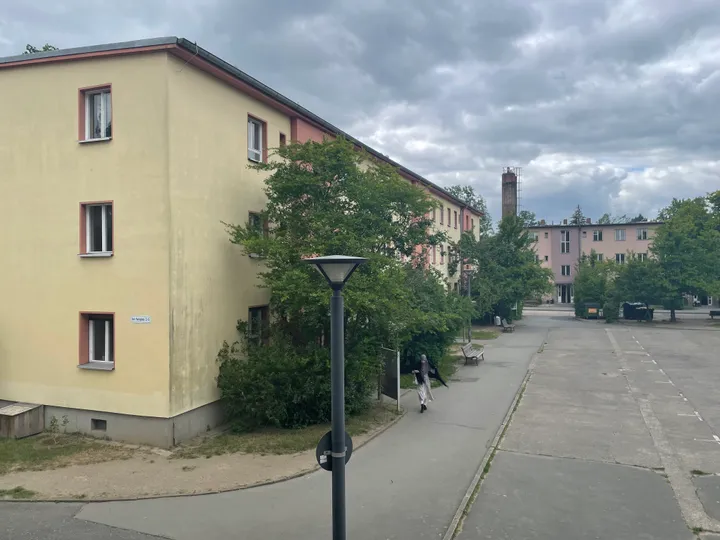
Das Notaufnahmelager von 1953, in dem 1,35 Millionen Menschen aus dem Osten ankamen, mit einem Mauerelement und einer Tafel draußen an der Marienfelder Allee.
Die ausführliche Geschichte, die Herkunft und die Quellenangaben dieses Eintrags liegen bislang nur auf Englisch vor.
The site at Marienfelde was opened as an emergency centre to process people arriving from the East, and is now a museum run by the Berlin Wall Foundation. Around 1.35 million people passed through Marienfelde between 1953 and 1990.
This record used to say there was no wall here. That was wrong. A wall element with a commemorative plaque stands in front of the museum on Marienfelder Allee, and the Foundation, which runs the site, lists it in its own directory of surviving traces as MAU-746, photographed in 2022. The record's pin had also been placed about half a kilometre south of the building; it now stands where the Foundation puts the element.
The element is still the smaller reason to keep the record. This catalogue is otherwise a list of concrete, and the concrete only means anything because of the movement it was built to stop. Marienfelde is where that movement arrived.
Wie kam es hierher?
Not established. The Foundation's directory records the element and its plaque without giving where it came from.
Quellen
Sites — Stiftung Berliner Mauer (Berlin Wall Foundation) ↗
The Foundation's own listing of the sites it runs and documents, with addresses and what survives at each.
Institutionelle QuelleQuelle abgerufen am 2026-09-17
MAU-746 Mauerelement vor der Erinnerungsstätte Notaufnahmelager Marienfelde — MAUERSPUREN, Stiftung Berliner Mauer ↗
A wall element with a commemorative plaque in front of the Erinnerungsstätte Notaufnahmelager Marienfelde on Marienfelder Allee, catalogued as MAU-746 and photographed in 2022.
Institutionelle QuelleQuelle abgerufen am 2026-09-17
Wissen Sie mehr über dieses Stück – wann es ankam, wer es gab, was auf der Tafel steht? Zu diesem Eintrag beitragen (Englisch)