The record
Hinterland wall built high and unusually smooth because a football crowd gathered beside it — now a park and a legal graffiti surface repainted continuously.
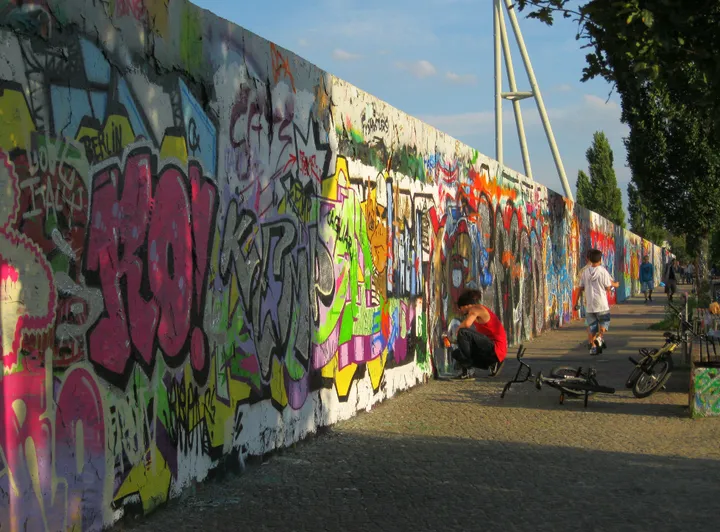
Around 300 metres of hinterland wall survive in three sections along the Friedrich-Jahn-Stadion at the edge of the Mauerpark, which occupies the old death strip between Prenzlauer Berg and Wedding. They were listed as monuments in 2001 and built into the park by the Hamburg landscape architect Gustav Lange, whose design was realised by Grün Berlin in 1993 and whose phrase for the work was turning border space into free space.
That the park exists at all is a consequence of what the ground was before. Other parcels of former no man's land were tied up in restitution claims or sold off; this one was open because it had never been built on. From 1820 it was a military parade ground called The Lone Poplar, and in 1848 it saw fighting in the March Revolution; the Stettin freight depot's tracks went in to the west of it in 1872; after 1914 it held allotments, makeshift housing and sports grounds. In GDR times it was the home ground of Dynamo Berlin, and a crowd gathered regularly beside the border — which is why the hinterland wall here was built especially high, with an unusually smooth surface, and set further back from the death strip than usual. The stadium explains the wall.
The wall is now a working graffiti surface, repainted constantly and legally. It raises the question the rest of this catalogue mostly avoids: whether a preserved object whose surface is replaced every few weeks is still evidence, or has become a support for something else. Christchurch answers it one way by commissioning repaints; Fort Knox and Portland answer it by accident.
How did it get here?
In place. Listed as a monument in 2001 and integrated into Gustav Lange's 1993 design for the park.
Sources & verification
Berlin Wall: where it still stands — Berlin.de ↗
The surviving hinterland wall at Mauerpark and Schwedter Straße.
Source accessed 2026-09-17
Mauerpark — Landesdenkmalamt Berlin, Wall monuments ↗
The park's extent and its design by Gustav Lange realised by Grün Berlin in 1993, the phrase about turning border space into free space, the site's history as the Lone Poplar parade ground from 1820 and its part in the March Revolution of 1848, the Stettin freight depot tracks of 1872 and the later allotments and sports grounds, Dynamo Berlin's ground beside the border and the consequently higher, smoother hinterland wall set further from the death strip, and the roughly 300 metres in three sections along the Friedrich-Jahn-Stadion listed in 2001.
Source accessed 2026-09-17
Last verified: Not yet verified
Our sourcing standardsKnow more about this piece — when it arrived, who gave it, what the plaque says? Contribute to this record