The record
A command post that ran eighteen watchtowers, saved by an art museum before the border regime was even wound up, and restored in 2004 to look its age rather than new.
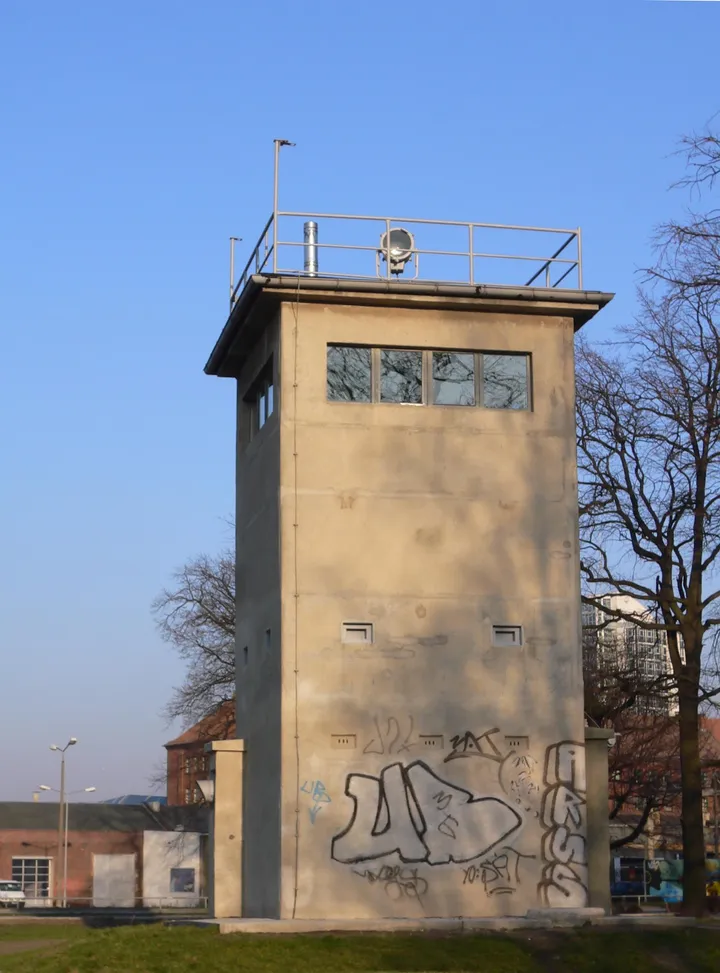
The tower in the Schlesischer Park on Puschkinallee, between Kreuzberg and Treptow, looks like a viewing platform put up for visitors. Only the rifle hatches and the searchlight on the roof, worked from below, say otherwise.
It was a command post: about ten metres high, 4.2 metres square, four floors of precast concrete, responsible for eighteen watchtowers and the electronic security along this section of the border. The base was underground and held the equipment and the telephone cables running to the surrounding observation towers. The ground floor had the entrance, a lavatory and a holding cell; above it the staff room for the commanding officer and three guards; on top the observation post, with panorama windows on all four sides, an electrical control panel for monitoring the border and the lever that swung the roof searchlight. Trapdoors and steep iron stairs joined the floors.
The hatches in the middle floor are the detail that repays attention. That floor was only a staff room, so they had no function at all. One explanation is that these command posts followed a design worked out for towers on the Soviet-Chinese border; another is that they were there to make the tower look well defended. Either way the tower was partly a costume.
It survives because the Museum der Verbotenen Kunst began working to preserve it before the border regime was formally wound up on 1 July 1990. It was listed in 1992 and restored in 2004, and the aim of that restoration is worth recording: not to return it to the condition of a new building but to keep what decades had made of it and stop further decay. Vandalism and graffiti damage were repaired, exposed structure renovated, cracks filled, the machine-applied plaster touched up with authentic material, and the interior repainted in the colour it had before 1989. The Flutgraben association next door now runs a permanent exhibition on the site and changing art shows in the tower.
North of Puschkinallee a slab wall from the border also survives, concrete panels between H-shaped supports, used as a perimeter defence in front of the border installations proper. It has been listed since 2005 and still does duty marking the boundary of the industrial premises beside it.
How did it get here?
In place. Preserved through the efforts of the Museum der Verbotenen Kunst from before 1 July 1990, listed as a monument in 1992 and restored in 2004 with funding from the Federal Employment Agency, the state of Berlin and the Treptow-Köpenick borough.
Sources & verification
Führungsstelle Schlesischer Busch — Landesdenkmalamt Berlin, Wall monuments ↗
The tower's position in Schlesischer Park, its rifle hatches and roof searchlight, its dimensions and four floors, its responsibility for eighteen watchtowers and the electronic security of the section, the layout of each floor including the holding cell, staff room and observation post with control panel and searchlight lever, the functionless hatches and the two explanations offered for them, its preservation by the Museum der Verbotenen Kunst before 1 July 1990, the 1992 listing and the 2004 restoration with its stated conservation aims and funders, the Flutgraben association's exhibitions, and the slab wall north of Puschkinallee listed in 2005.
Source accessed 2026-09-17
Last verified: Not yet verified
Our sourcing standardsKnow more about this piece — when it arrived, who gave it, what the plaque says? Contribute to this record