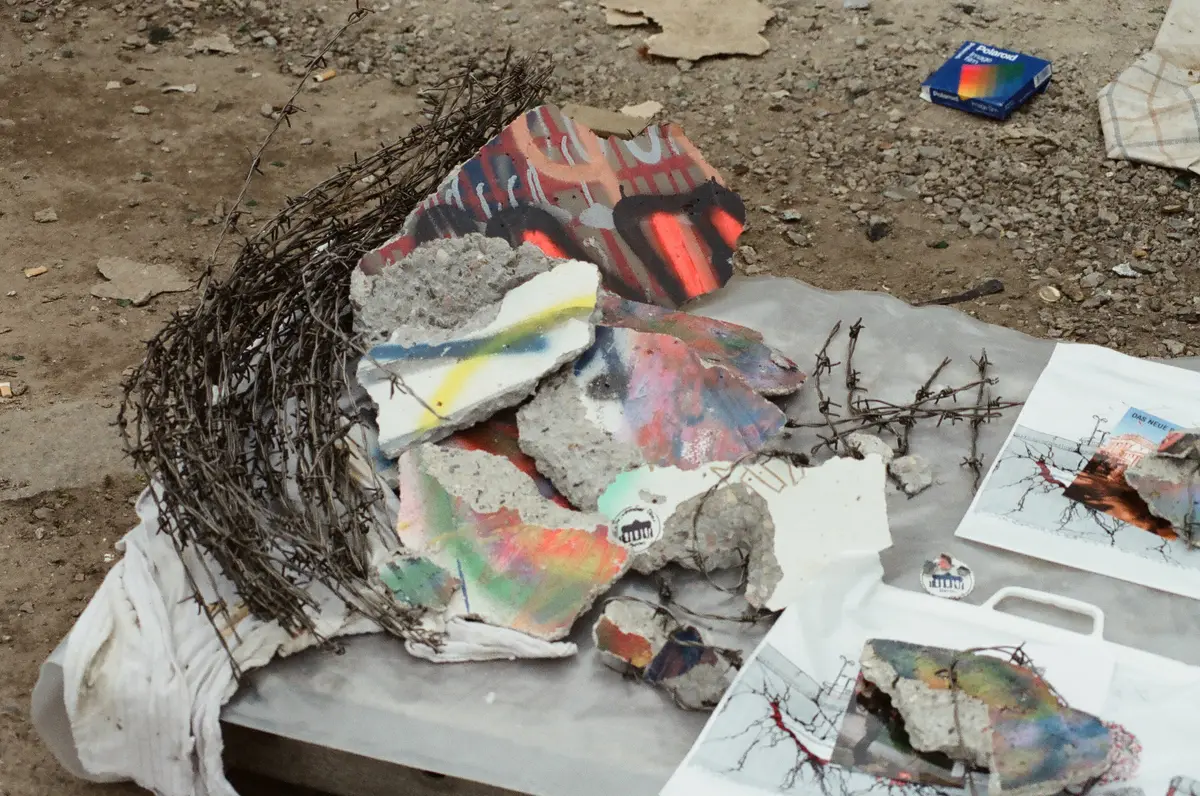
Someone has probably offered you a piece of the Berlin Wall. They are on market stalls in Berlin, in airport gift shops, in museum stores on other continents, and in their thousands on auction sites. Some of them are exactly what they say they are. A great many are not, and the reason is arithmetic rather than wickedness.
The supply is a closed set and it is small
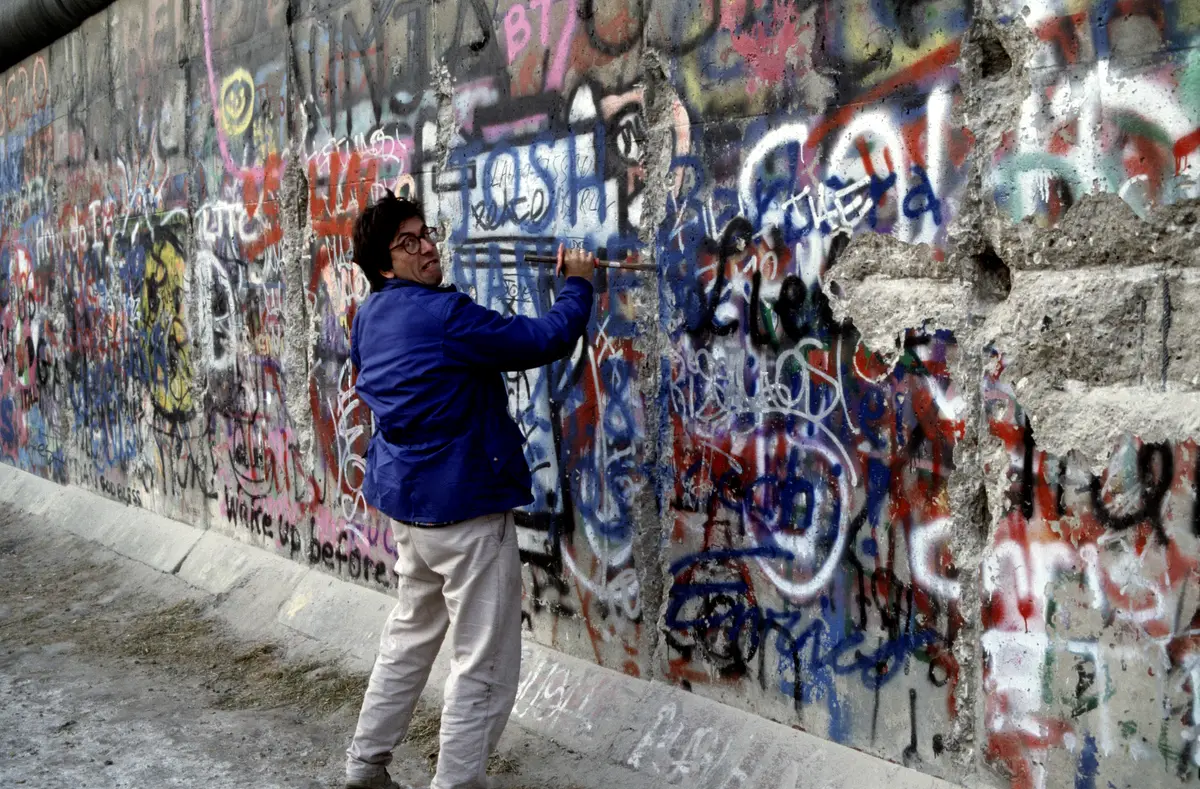
There were roughly 45,000 concrete elements in the Wall. Only one face of it was ever painted before 1989 — the outer side, facing West Berlin — and that face was the first thing the Mauerspechte chipped away in the winter of 1989. Most of the rest was crushed for road aggregate during 1990.
So the quantity of genuine, pre-1989, painted Berlin Wall in the world stopped growing in 1990 and has been shrinking ever since. Demand has had thirty-five years to grow. When a fixed supply meets a growing market, the gap gets filled.
How it was filled
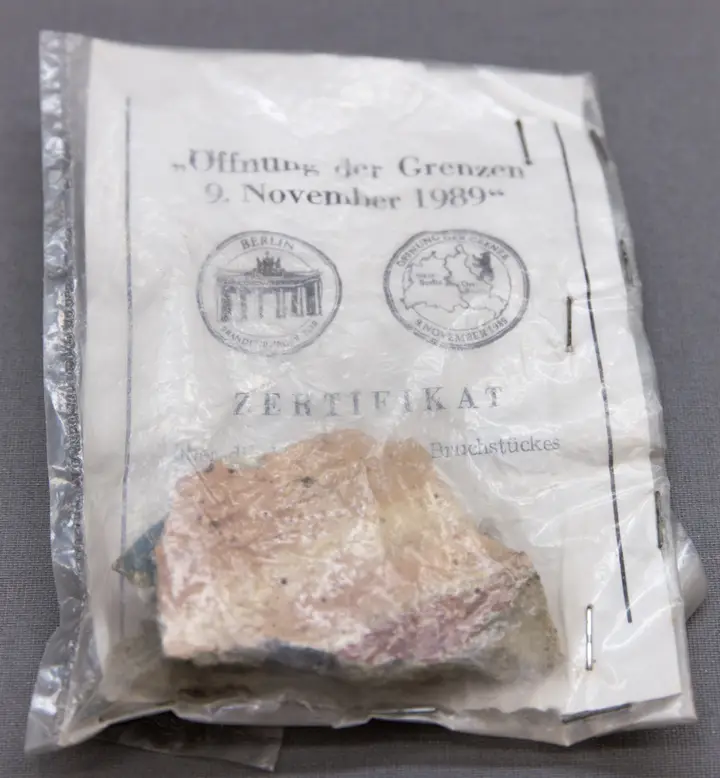
It was filled from the beginning. Gravel was being sold in bags with certificates near the Brandenburg Gate within weeks of the border opening. Dealers have openly re-sprayed plain fragments so that they look the way a buyer expects. The word authentic is printed on more or less everything.
The official trade was not obviously cleaner. The East German foreign trade company issued certificates of authenticity for segments that its West Berlin sales partner had commissioned artists to paint or retouch before the sale — the product improved for market, then certified. The concrete was real. The picture on it was a month old.
Three questions, not one
Asking whether a fragment is real is the wrong question, because there are three different claims bundled inside it.
- Material Is the concrete from the Wall? Largely unprovable for a small fragment.
- Decorative Was the paint applied in Berlin before November 1989? Where most souvenirs fail.
- Documentary Is there a chain of paperwork or photographs? The rarest, and the most valuable.
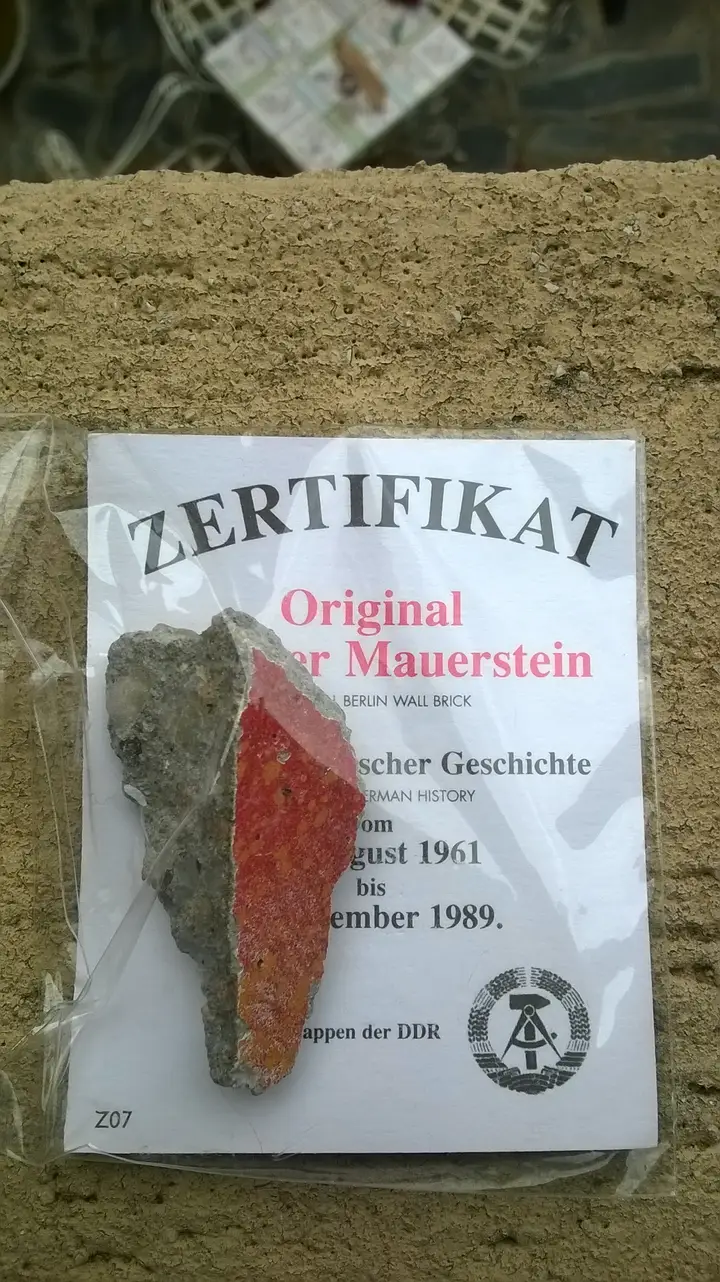
Material provenance. Is this concrete from the Berlin Wall? Hard to prove for a small fragment, and largely unprovable without documentation, since the elements were mass-produced from ordinary materials.
Decorative provenance. Was the paint on it applied to the Wall while the Wall was standing, in Berlin, before November 1989? This is where most souvenirs fail, including honest ones. Paint applied in 2009 to genuine concrete is a genuine object with a false impression.
Documentary provenance. Is there a chain of paperwork or photographs? This is the rarest and the most valuable. The Kiddy Citny hearts have it because the photographers Liselotte and Armin Orgel-Köhne photographed them on Waldemarstraße in 1985, which is why the halves of one of them can be tracked from Berlin to a New York museum ship to a New Jersey store.
Most souvenirs have one of the three. That is fine, as long as nobody pretends otherwise.
What the market has actually paid
Published prices for whole elements, which are easier to trace than fragments, give a rough curve. In 1990 a segment sold for tens of thousands of marks: 20,000 for the Merone element at the Monaco auction, over 100,000 for a pair bought there by a Swiss businessman, 35,000 dollars for the one presented to the Gerald R. Ford Presidential Library in 1991. A Mexican school board negotiated two down from 100,000 marks to 30,000 on the grounds that they were for German schools. A Japanese municipality paid six million yen — about 60,000 marks — for two.
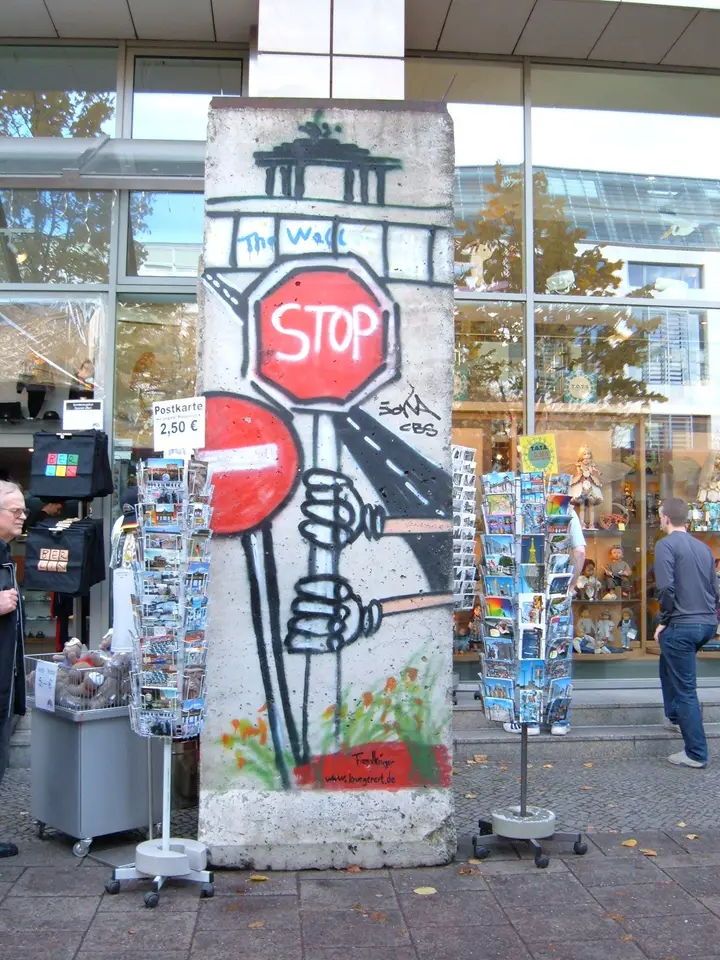
By 2005 a segment with a Kiddy Citny painting went at a German auction for 7,000 euros. In 2019 two elements sold in London for £12,000 and £5,000.
One number from the same period is worth putting beside those. At Monaco in 1990, Japanese buyers bid 40,000 marks for a blue segment with an orange woman's head and then declined to take it. It was never collected, and it stands today in a meadow in Lower Silesia with forty-two others.
What we do about it here
This atlas applies the same standard to itself. Every record is marked Reported, never Verified: it means a credible source says the object is there, not that anyone has confirmed it in person. Where two sources disagree, both readings are kept. Where a coordinate cannot be right, the pin is removed rather than left on the map — ten of them so far.
There is no test that will tell you whether the chip of concrete on your shelf came off the Grenzmauer 75. What you can establish is which of the three claims it actually supports, and the honest answer is usually more interesting than the certificate.
Sources
- Chipping away at Berlin Wall souvenir myths — The LocalThe re-spraying of fragments for sale and the unreliability of authenticity claims in the souvenir market.
- Where Have All the Fragments Gone? — Lapham's QuarterlyThe scale of the dispersal, the commercial sale, and the difficulty of establishing provenance for fragments.
- The Wall for sale — The BerlinerThe commissioning of artists to paint and retouch segments before sale, and the certificates issued for them.
- Federal Foundation — Berlin Wall worldwide, Merone site entryThe purchase of a segment for 20,000 marks at the Monaco auction of June 1990.
- Federal Foundation — Berlin Wall worldwide, Cala Vadella site entryA segment painted by Kiddy Citny, unsold in 1990, auctioned in Germany in spring 2005 for 7,000 euros.
- Federal Foundation — Berlin Wall worldwide, Mexico City site entryThe negotiation of two segments down from 100,000 to 30,000 marks for the German schools in Mexico City, with proceeds pledged to the Charité.
- Federal Foundation — Berlin Wall worldwide, Ueno site entryThe purchase of elements 166 and 167 from Limex for six million yen, about 60,000 marks.