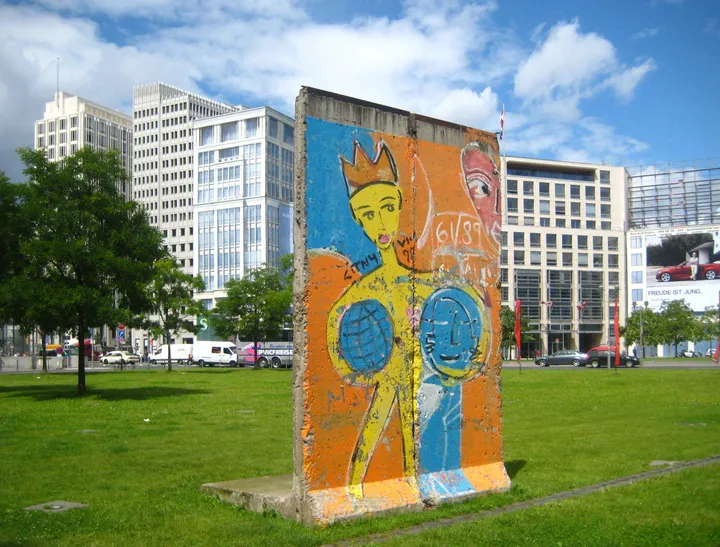
The record
The inner wall built to look like the outer one, because the GDR wanted the view from the Western viewing platforms to look tidy.
Potsdamer Platz and Leipziger Platz were one of the great urban centres of Europe, and the Wall turned them into no man's land. Everything that had survived the war was pulled down for the border strip apart from the Grandhotel Esplanade and the Weinhaus Huth, and the lost Potsdamer Platz became an attraction in its own right, familiar from Wim Wenders's Wings of Desire. After 1990 the area was rebuilt in a few years as Europe's largest building site, and nearly every trace of the border went with it.
One piece survives at its original location, on the corner of Stresemannstraße and Erna-Berger-Straße: a section of hinterland wall with the knee-high red and white barrier piping still in front of it. It stood against the fire wall of the neoclassical extension built for the Prussian agriculture ministry between 1913 and 1919, and ran from there diagonally across the octagonal Leipziger Platz towards the Brandenburg Gate.
The interesting thing about it is that it is the wrong shape. The hinterland wall — the inner wall, facing East Berlin — was normally a cruder structure than the outer one. Here it was built in the Grenzmauer 75 form otherwise reserved for the border wall facing west, and the reason is recorded: the GDR wanted a more orderly view for the tourists looking over from the West Berlin side, and its leadership welcomed the new wall on the grounds that it would further enhance the political appeal of the capital at the sightseeing attractions of the Brandenburg Gate and Leipziger Platz. The inner wall at the most photographed point on the border was dressed to be photographed.
What little remains has been listed since 2001, and the plans for the federal environment ministry's Berlin building include taking the Stresemannstraße section into the foyer.
How did it get here?
In place. Listed as a monument since 2001. Built in the Grenzmauer 75 form normally used only for the outer wall.
Sources & verification
Leipziger Platz — Landesdenkmalamt Berlin, Wall monuments ↗
The transformation of Potsdamer Platz and Leipziger Platz into no man's land and the demolition of all but the Grandhotel Esplanade and Weinhaus Huth, the post-1990 rebuilding, the surviving hinterland wall with its barrier piping at the corner of Stresemannstraße and Erna-Berger-Straße and its line across Leipziger Platz, its construction in the Grenzmauer 75 form and the GDR's stated reason of presenting an orderly view to Western tourists, the 2001 listing, and the plan to integrate the section into the environment ministry's foyer.
Source accessed 2026-09-17
Last verified: Not yet verified
Our sourcing standardsKnow more about this piece — when it arrived, who gave it, what the plaque says? Contribute to this record