The painted Berlin Wall is one of the most reproduced images of the twentieth century, and it was made by a small number of identifiable people, several of whom are still working. Their paintings are now scattered across dozens of countries, usually credited to nobody.
- 1984Thierry Noir begins painting the outer face. Kiddy Citny’s hearts on Waldemarstraße date from 1984 or 1985; the sources differ
- 1985Liselotte and Armin Orgel-Köhne photograph the Waldemarstraße paintings
- Nov 1989The border opens. Indiano paints a reported 223 sections in seven months
- Spring 1990106 murals on the inner wall at the East Side Gallery, organised by Kani Alavi
- June 1990The Monaco auction: 81 segments, 33 by Noir and 12 by Citny
- Dec 1990Noir and Citny win at first instance; they lose on appeal
- 1995The artists obtain a retroactive share of the profits
- 2011The east-facing backs on Wilshire Boulevard are painted for the first time
Thierry Noir
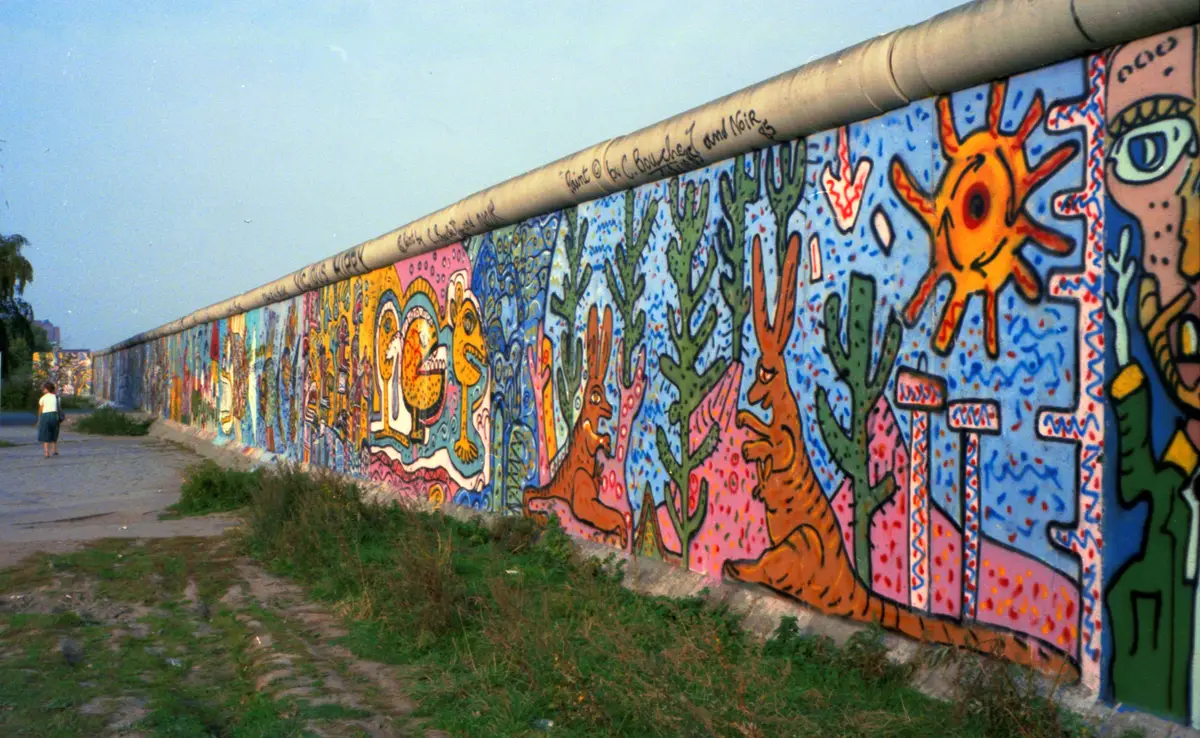
A French artist in West Berlin, painting the outer face of the Wall from 1984. His account of the method is the useful part: he painted fast, with big simple heads in flat colour, because standing at the Wall was not a safe place to work slowly. The ground immediately in front of the outer wall was often still GDR territory, and the border troops had doors built into the structure from 1978 partly so that they could come out and remove graffiti.
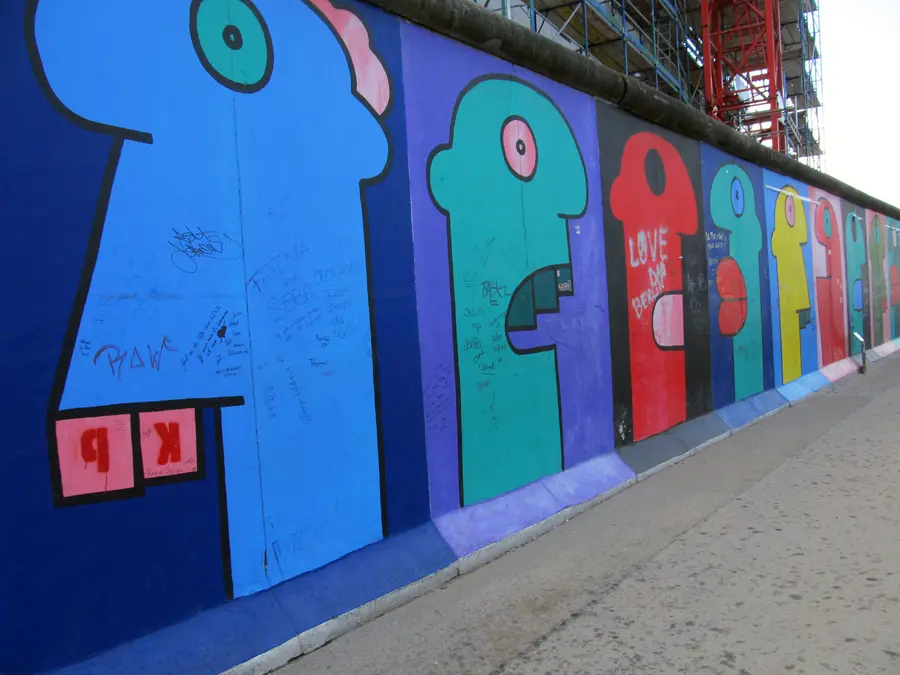
Noir's heads travelled further than anyone's. They are on the segment at the Wende Museum in Culver City, on one of the ten elements on Wilshire Boulevard, on one of five sent from a Teltow builders' yard to a peace park in South Korea, and on two segments in the garden of the German embassy in Bangkok. He also went to a village in Lower Silesia to paint unpainted segments in a private collection, and repainted the owner's bathroom while he was there.
Kiddy Citny
Citny painted crowned hearts and figures on Waldemarstraße in West Berlin in the mid-1980s; the sources differ on the year, giving 1984 for the hearts and September 1985, and both readings are kept here. Two hearts spread across four elements are among the best-documented objects in this catalogue, for one reason: the photographers Liselotte and Armin Orgel-Köhne documented the Waldemarstraße paintings in 1985, and the pictures were used widely for Berlin's 750th anniversary in 1987. Datable photographs are what provenance is made of, and almost no other painted segment has them.
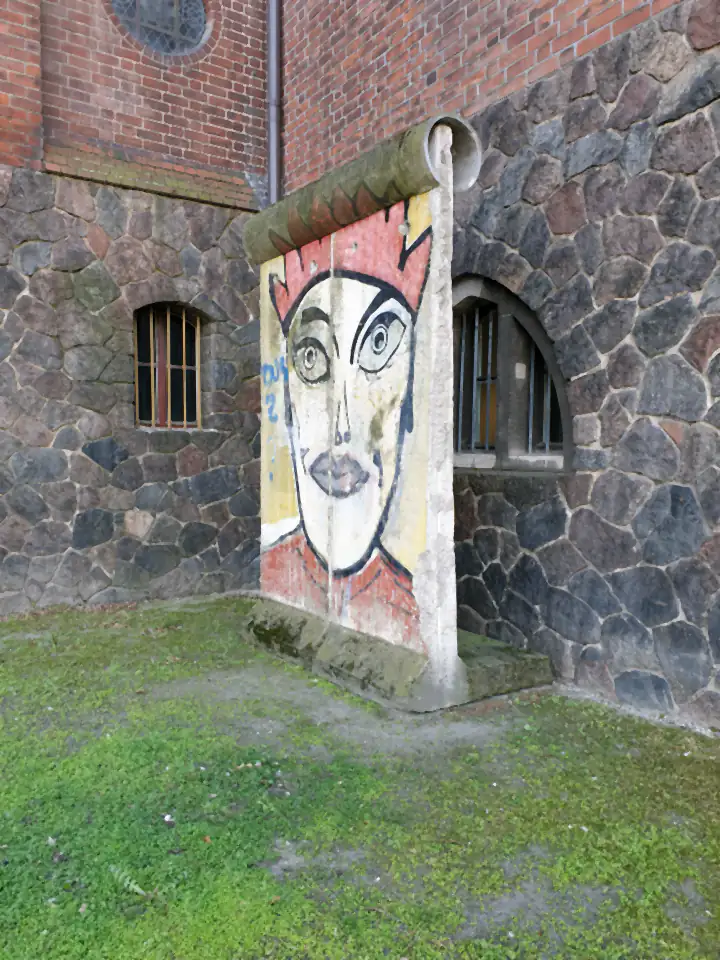
Those four elements can now be accounted for individually. Two were sold at the Monaco auction in June 1990 and stand on a private plot near Basel. The other two went to the United States in January 1990 as the first complete elements shipped there legally — and in October of that year the dealer who owned them sawed the heart in half to make a sale, sending the right side to North Carolina and leaving the left on the museum ship USS Intrepid. The left half is now in the owner's store in New Jersey.
Five more Citny and Noir segments stood for years in a courtyard on Madison Avenue in New York and are now in a depot in Connecticut. They are visible in Wim Wenders's Wings of Desire.
Jürgen Große, who signed himself Indiano
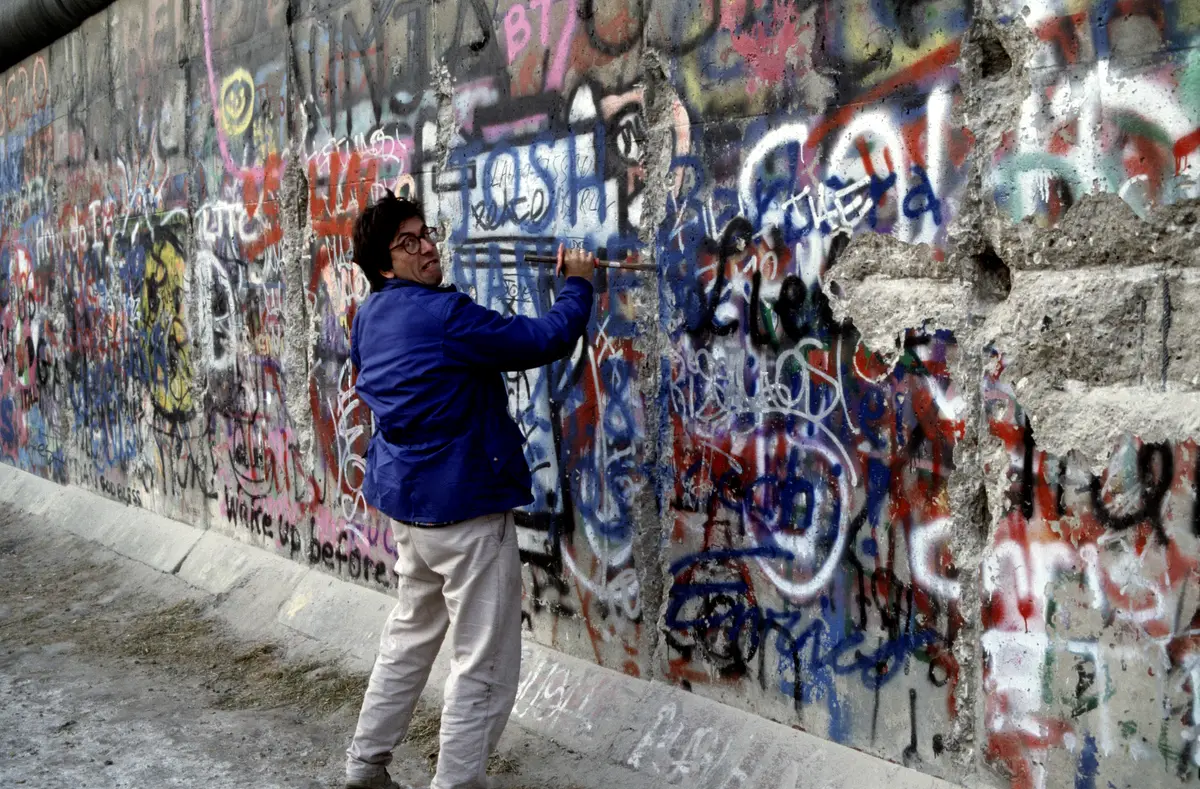
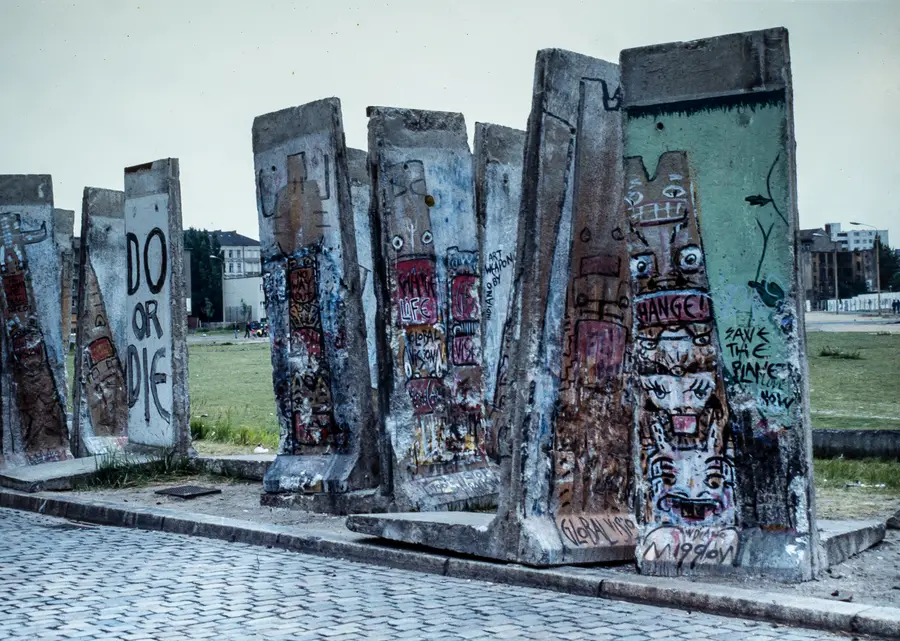
Große painted after the border opened, racing the demolition crews: a reported 223 sections in seven months, in a series he called his Global Messages. Two of them illustrate what open-air display costs. The segment at the Yorkshire Sculpture Park has been rained on for twenty-five years and its message is almost entirely gone; the words Fight your inner can just be made out. A segment from the same purchase, kept in a glass case at a Pennsylvania resort, still reads Change myself and Wake up.
Kani Alavi
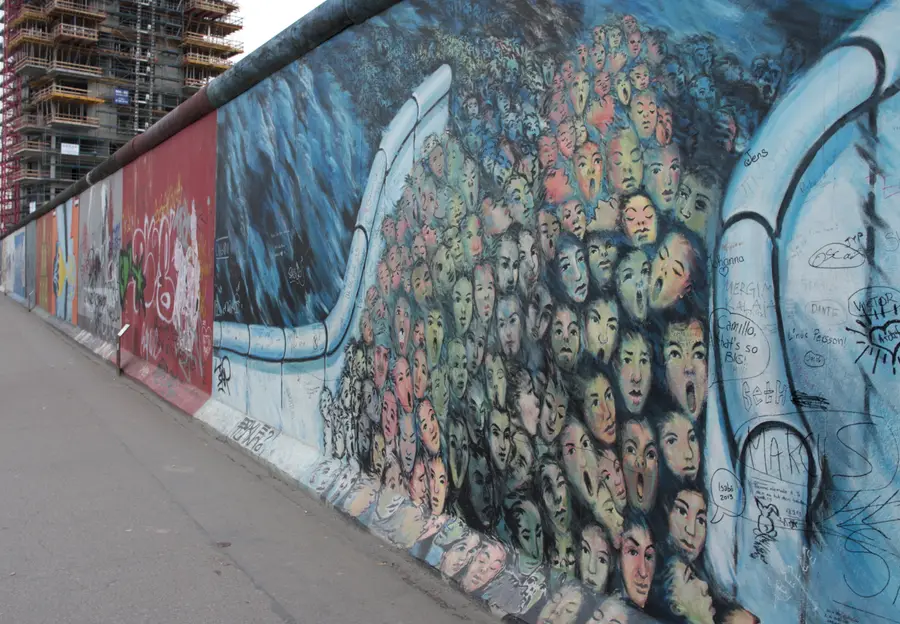
Alavi organised the artists of the East Side Gallery and painted the face that now looks out over the sculpture garden at the United Nations in New York. Those three segments were given to Kofi Annan in Berlin in July 2001, over the objection of the man who had bought the ground they stood on and wanted the remains of the border left in place. The agreement that released them included an undertaking that the rest of that stretch, and the watchtower with it, would stay where they were.
They sued, and mostly lost
When the East German state sold the painted segments in 1990, it was selling other people's work. The Monaco catalogue listed 81 segments, of which 33 were painted by Noir and 12 by Citny. The two artists went to court; they won at first instance in December 1990, including the right to ask where the proceeds had gone, lost that on appeal, and obtained a retroactive share of the profits in 1995.
- Thierry Noir, 33
- Kiddy Citny, 12
- Other or unattributed, 36
The rights did not stop travelling when the concrete did. Photographing a painted segment is a copyright question, and Germany's freedom of panorama — which permits photographs of works permanently in public places — does not exist in the same form in many of the countries where segments now stand.
The one installation that answers back
In 2011 the Wende Museum invited DFace, RETNA and the German duo Herakut to paint the east*-facing backs of the nine segments on Wilshire Boulevard: the faces that, in Berlin, nobody could have reached without being shot at.
It is, as far as this catalogue can establish, the only place in the world where the other side of the Berlin Wall has been painted at all. The full run of ten is the longest stretch standing outside Berlin.
Sources
- Art and the Berlin Wall — Imperial War MuseumsThe artists who painted the Wall, their methods and the fate of their work after 1989.
- The Story of the Berlin Wall — Thierry NoirNoir's own account of painting the outer face of the Wall from 1984 and the conditions he worked in.
- A partial victory for the wall artists — tazThe Monaco catalogue's 81 segments, of which 33 were painted by Noir and 12 by Citny, the first-instance judgment of December 1990, the appeal, and the retroactive profit-sharing of 1995.
- Federal Foundation — Berlin Wall worldwide, Lyndhurst site entryThe Citny heart shipped to the United States in January 1990, its display on the USS Intrepid, and the splitting of the heart in October 1990 with the right half sent to North Carolina.
- Federal Foundation — Berlin Wall worldwide, Connecticut site entryThe five Noir and Citny segments painted on Waldemarstraße in October 1985, photographed by Liselotte and Armin Orgel-Köhne, visible in Wings of Desire, and now stored in Connecticut.
- Federal Foundation — Berlin Wall worldwide, New York site entryThe three Leipziger Platz segments with Kani Alavi's painting given to Kofi Annan on 13 July 2001, the dispute over their removal, and the undertaking to leave the remaining segments and watchtower in place.
- The Wall Project — Wende Museum via Google Arts & CultureThe Wilshire Boulevard installation and the 2011 painting of the east-facing sides by D*Face, RETNA and Herakut.
- Commons:Freedom of panorama — Wikimedia CommonsThe variation in freedom of panorama between Germany and other countries, which governs photographs of painted segments.